


Car Wash Tunnel Lighting — Why US Operators Choose High-Power RGBW LED Light Bars
The commercial logic, technical demands and installation practice behind RGBW light bars in car wash tunnels.
The Commercial Logic Behind RGBW in Car Wash Tunnels
US car wash operators did not adopt RGBW lighting because it looks impressive. They adopted it because it measurably increases revenue. In a modern express tunnel wash, each service stage corresponds to a specific product: the foam bath, the rainbow coat, the ceramic wax, the tyre shine, the hot air dryer. Customers could not see what they were paying for.
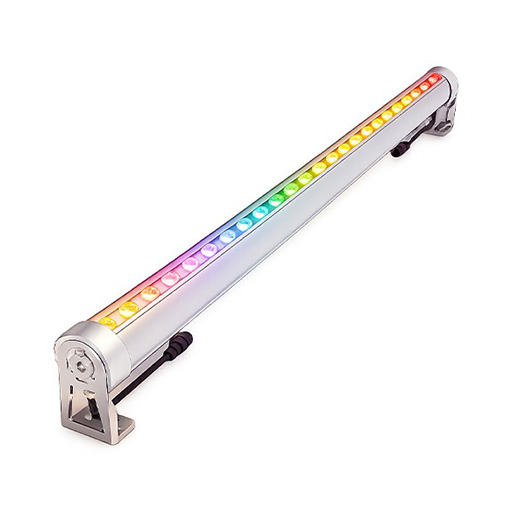
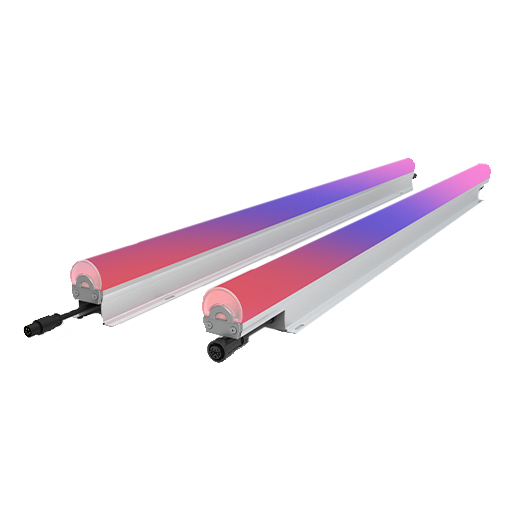
RGBW lighting changed that. Each stage now carries a colour signature — the foaming stage lights the tunnel in deep violet, the rainbow coat triggers a full-spectrum cycle, the wax arch holds warm amber. The wash becomes a show, and the customer watches their premium package being delivered in vivid colour. Operators who retrofit RGBW tunnel lighting consistently report higher upgrade conversion rates, improved membership retention and stronger social-media engagement.
Why Car Wash Is One of the Most Demanding LED Environments
A car wash tunnel presents a more aggressive combination of environmental stressors than most outdoor architectural applications: high humidity and direct water spray, chemical exposure (soap, wax, tyre shine, acid-free cleaners), temperature swings, vibration from machinery and pressure-washing impact.
A standard tunnel is roughly 2.4–3 m wide and 24–55 m long, with fixture mounting heights typically 2.4–3.6 m. Producing saturated colour that fills the tunnel — colour the customer sees wrapping around the vehicle — requires significantly more luminous power than facade lighting.
Why High Power and Large Format Matter
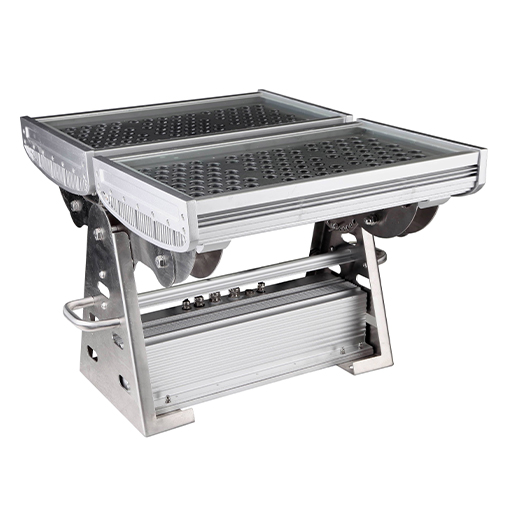
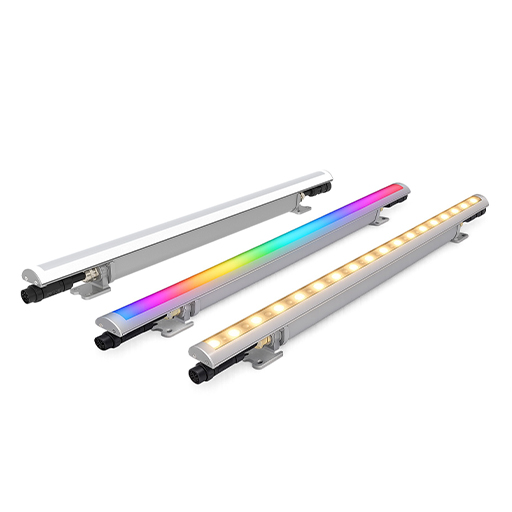
Operators specify 150 W+ light bars rather than multiple lower-wattage fixtures for two reasons: luminous power sufficient for saturated colour across the tunnel width, and the visual quality of a single continuous band of colour across the full arch — more cinematic and premium than the same output from multiple point sources.
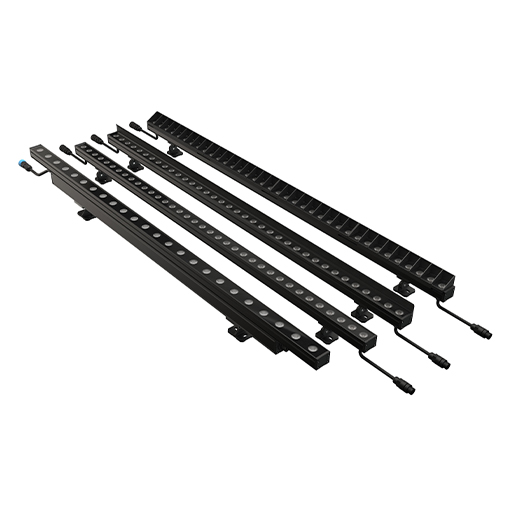
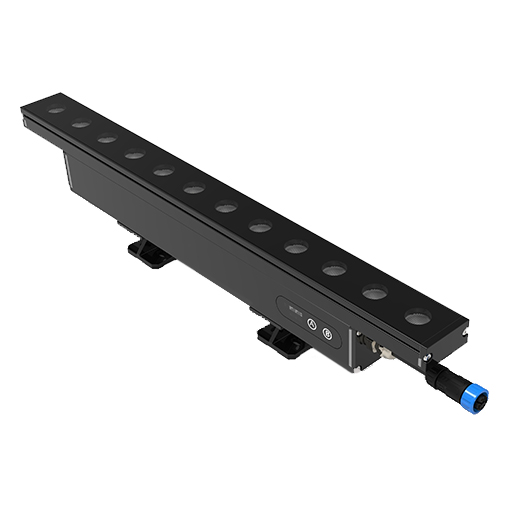
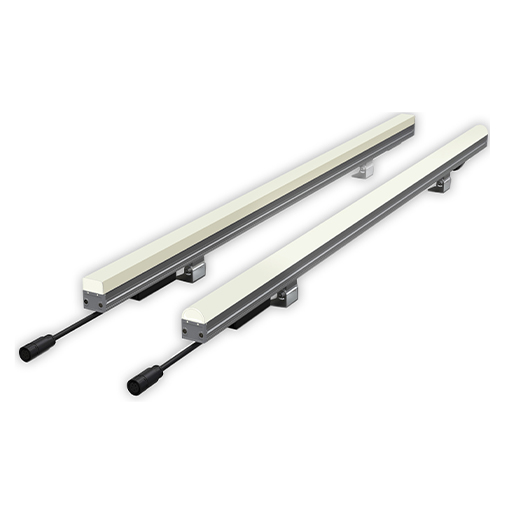
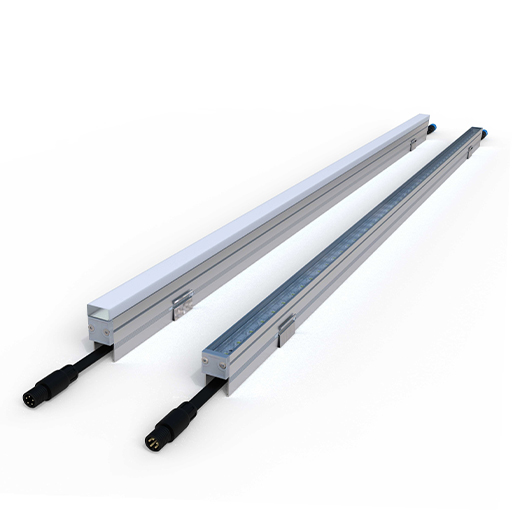
LWW-ROWS-W150 — Product Specification
| Parameter | Specification |
|---|---|
| Type | High-power RGBW linear LED light bar |
| Typical power | 150 W class |
| Protection | IP67 |
| Certification | ETL listed (Intertek), accepted by US AHJs |
| Mains | 100–277 V AC, built-in driver — no external transformer |
| Control | DMX512 with RDM addressing; built-in colour-cycling effects via onboard button |
| Connectors | Quick-connect push-lock for power and DMX — tool-free swap |
The LWW-ROWS-W150 was supplied to a major US car wash equipment distributor and is deployed across express tunnel sites throughout the United States, as visible in the installation configurations described below.
Beyond Car Wash: Other High-Wet and Chemical Environments
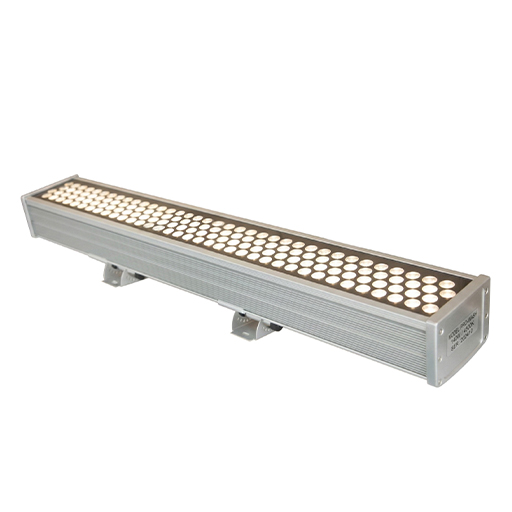
The combination that suits car wash tunnels — IP67 protection, large-format aluminium housing, high power output and ETL certification — also suits other demanding wet and industrial applications: wash bays, food-processing areas, chemical storage and processing environments, marine and coastal facilities, and high-pressure cleaning zones.
Installation Considerations
US operators typically mount bars in dual or triple-row stacked configurations on each tunnel arch. Dual-row doubles visual output; triple-row serves premium installations. TPK supplies custom stacking brackets. A typical tunnel may have 4–10 arches with 2–3 bars per arch, each arch assigned its own DMX start address so different service stages trigger different colour scenes simultaneously; RDM allows addresses to be assigned and verified from the controller without touching each fixture.
Each fixture connects directly to the branch AC circuit. For a dual-row six-arch installation (12 fixtures at up to 150 W each), total circuit load is approximately 1,800 W. A qualified electrician should determine branch-circuit sizing and cable routing.
Engineering FAQ
Why RGBW in a car wash tunnel instead of white light?
RGBW turns each service stage into a visible, colour-coded performance, which operators report raises upgrade conversion, membership retention and social-media engagement — the investment pays back through the revenue it drives.
Why 150 W+ bars instead of several smaller fixtures?
Saturated colour across a full tunnel width needs high luminous power, and a single continuous bar across the arch reads as more premium than multiple point sources.
Is ETL listing accepted in all US states?
ETL (Intertek) is functionally equivalent to UL and is accepted by authorities having jurisdiction across US states; it is typically required by insurers and building authorities for commercial car wash installations.